Counselor Keri
Launch Pad: Executive Function Toolkit for Elementary | Routines, Getting Started, Following Directions, and Focus | Grades 2–4
Launch Pad: Executive Function Toolkit for Elementary | Routines, Getting Started, Following Directions, and Focus | Grades 2–4
Couldn't load pickup availability
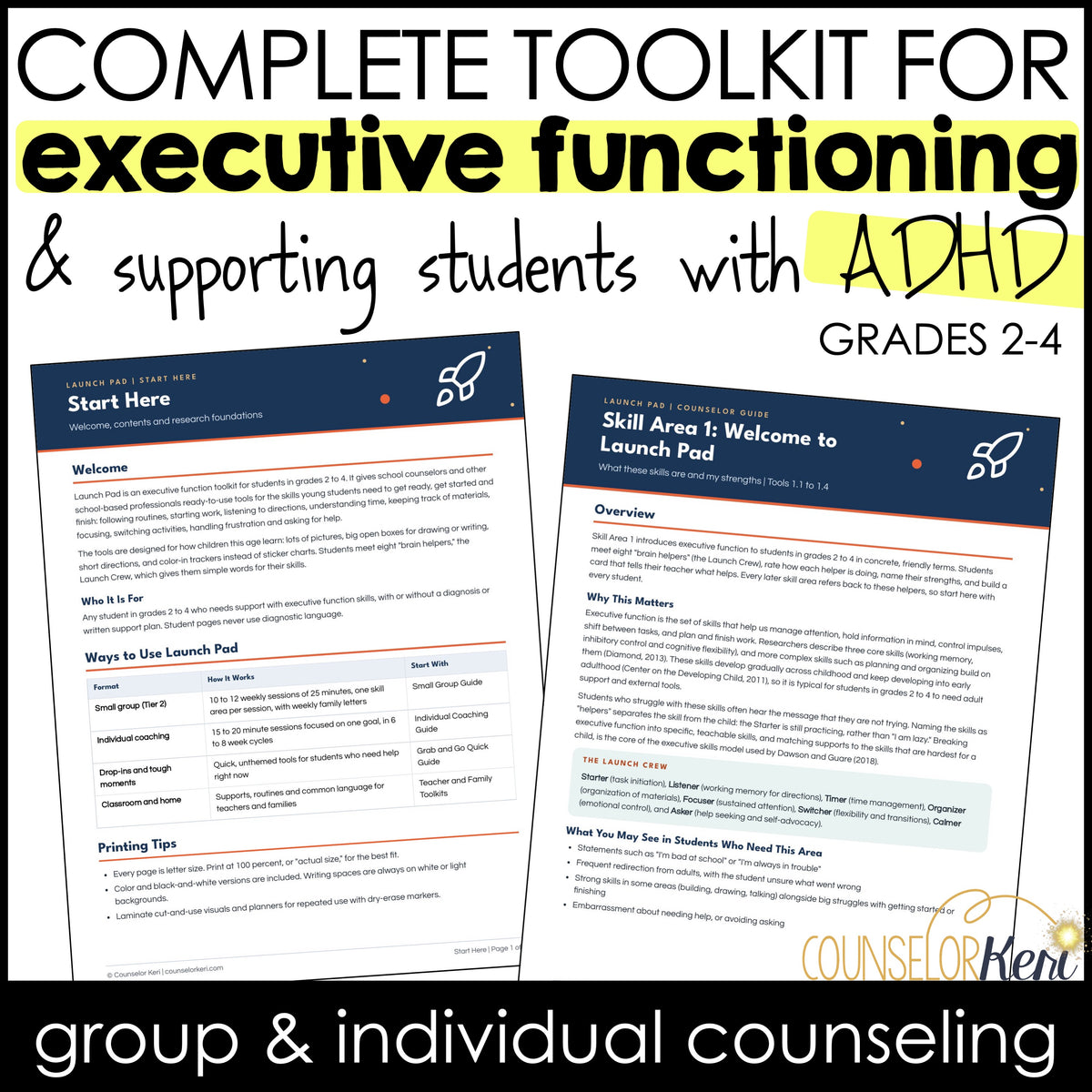
A complete, ready-to-use executive function toolkit for young students who struggle with getting ready, getting started, following directions, keeping track of their things, and finishing their work.
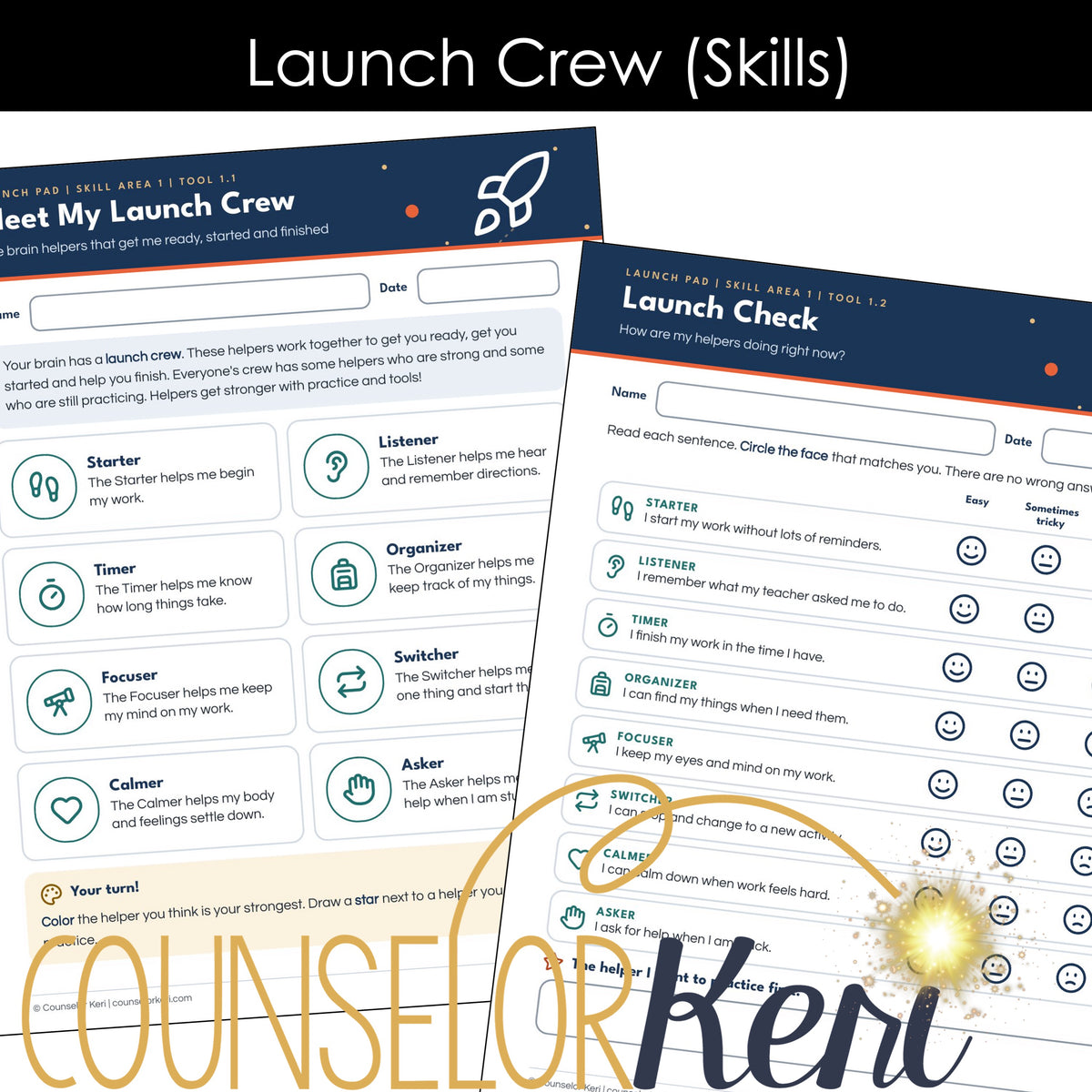
Launch Pad helps students build the skills behind a smooth school day: following routines, starting work, listening to and remembering directions, understanding time, keeping track of materials, focusing, switching activities, handling frustration, and asking for help. Every student page uses a space theme. Students meet the Launch Crew, eight “brain helpers” with simple names like the Starter, the Focuser, and the Asker, which gives young children kid-friendly words for their skills. Pages are designed for how children this age learn: lots of pictures, big open boxes for drawing or writing, short directions, and color-in trackers instead of sticker charts. It’s designed with students with diagnosed or suspected ADHD in mind, and works for any student with executive function challenges.
This toolkit supports Tier 3 individual coaching, Tier 2 small groups, Tier 1 classroom supports, and quick drop-in visits. It’s built for students who wander during morning routines, can’t get started without an adult nearby, miss parts of directions, lose their supplies, have messy desks and backpacks, have trouble stopping a fun activity, melt down when work feels hard, or sit stuck instead of asking for help.
How It Works
- Identify: Students complete a Launch Check to rate how their eight helpers are doing. Counselors combine it with a teacher observation form to choose 1 or 2 skill areas to work on first.
- Teach and Try: Students learn one tool at a time with a read-aloud script and modeling, practice it together, and choose one “tryout” strategy to use before the next session. Then they report back: how did it go?
- Keep It Going: Students collect the strategies that worked into My Launch Plan, color in their progress, and keep skills going with Booster tools after the work ends.
What’s Included
- Start Here section with a welcome and overview, ways to use the toolkit, complete table of contents, the Launch Crew at a glance, and research foundations
- 40 student tools across 10 executive function skill areas, plus 2 blank versions you can fill in for your own students
- 10 counselor guides with the purpose, how to use, read-aloud scripts, and facilitation notes for every tool, plus ASCA Mindsets and Behaviors alignment
- My Launch Plan capstone and Booster tools (Booster Menu, Booster Path, and My Wins) with counselor guides
- Individual Coaching Guide: coaching model, first meeting, typical session routine, “Which Tool?” quick guide, partnering with teachers and families, fading support, troubleshooting, student intake, teacher and family input forms, coaching plan, session log, student check-in, and cycle review
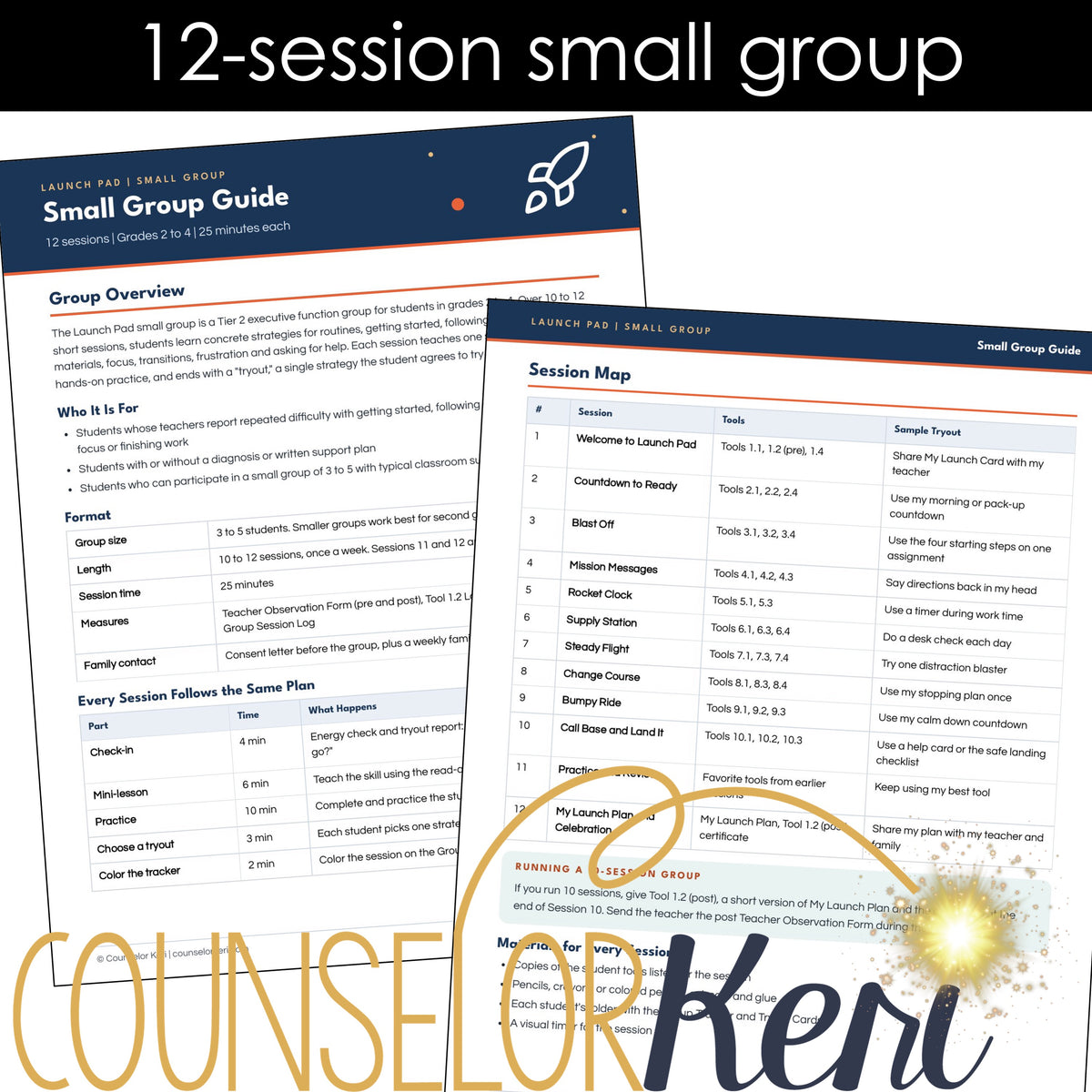
- 12-session Small Group Curriculum with 25-minute session plans, data-based student selection sheet, Teacher Observation Form (pre/post), Group Session Log, pre and post results summary, and family consent letter
- Small group student pages: Crew Agreements, My Launch Pad Tracker for coloring in each session, Tryout Cards, and completion certificate
- 12 weekly family letters with a plain-language summary of each session, questions to ask at home, and ways to support
- Teacher Toolkit (9 tools plus 5 prompt cards): executive function in grades 2 to 4, classroom supports menu, setting up calm and predictable routines, giving directions that stick, picture schedules and timers, responding to “I can’t,” common language card, daily check-in form, EF-friendly worksheet checklist, and teacher prompt cards
- Family Toolkit (9 tools plus 3 blank routine charts): understanding executive function, morning, after-school, and bedtime routine charts, homework and reading routine, coaching phrases, partnering with school, family phrase card, and screens and sleep agreement
- Data and Planning Tools (7 tools): intervention planning sheet, daily goal chart, progress graph, goal ladder, My Week Check, caseload tracker, and results summary
- Cut-and-Use Visuals (8 sets): Launch Crew helper cards, desk checklist strips, First-Then board, Now and Next cards, help and break cards, picture task tiles, color-in timers, and folder and home labels
- 22 Grab and Go tools: one-page tools for drop-in visits, plus a counselor quick guide and drop-in note
- Color and black-and-white versions of everything (219 printable pages in each version)
The 10 Skill Areas
- Understanding executive function and personal strengths
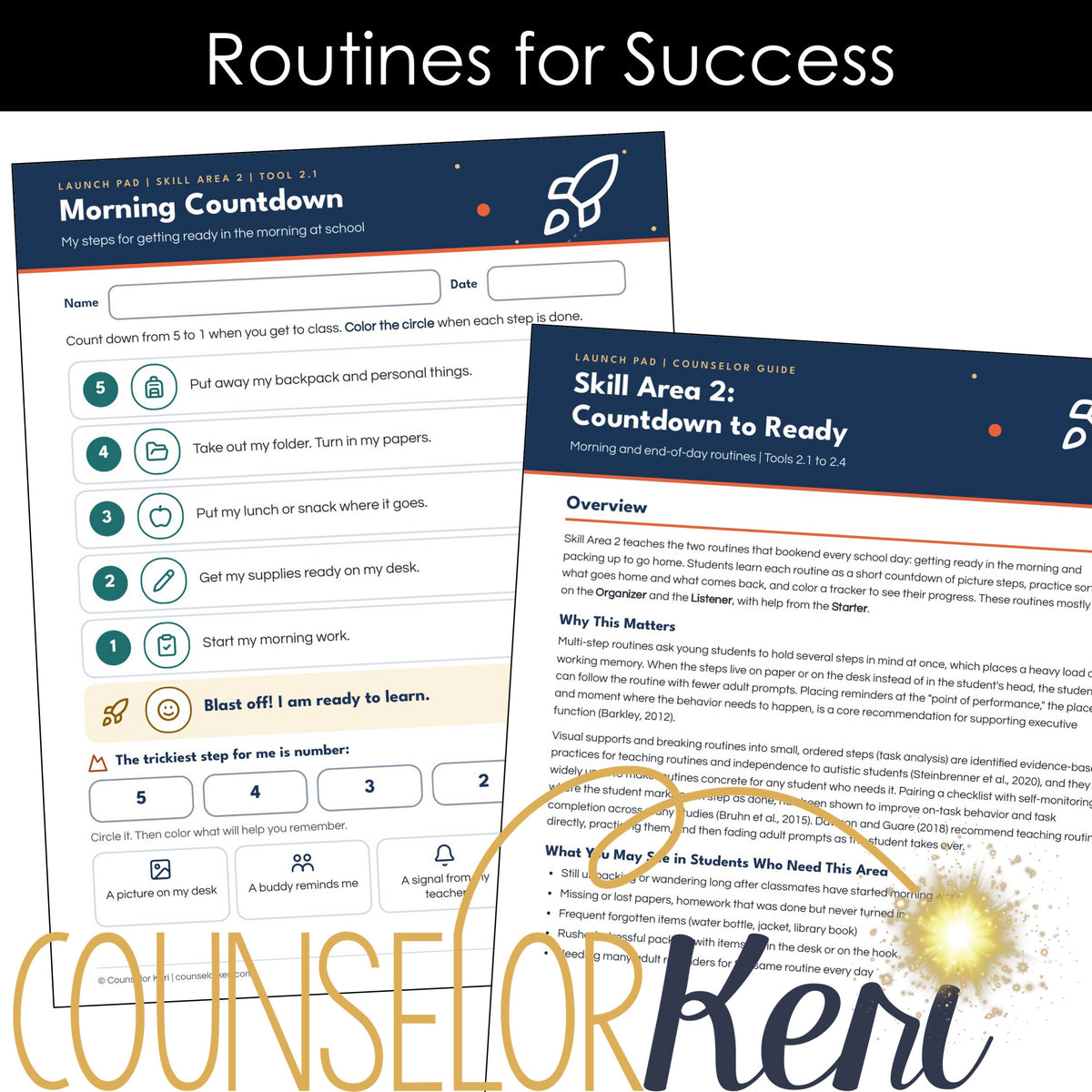
- Morning and end-of-day routines
- Getting started on tasks
- Listening to and following directions
- Understanding time
- Keeping track of materials
- Focus and managing energy
- Switching between activities
- Handling frustration when work feels hard
- Asking for help and finishing work
Meet the Launch Crew
- The Starter helps me begin my work.
- The Listener helps me hear and remember directions.
- The Timer helps me know how long things take.
- The Organizer helps me keep track of my things.
- The Focuser helps me keep my mind on my work.
- The Switcher helps me stop one thing and start the next.
- The Calmer helps my body and feelings settle down.
- The Asker helps me ask for help when I am stuck.
Grab and Go Tools for Drop-In Visits
- My Plan for Right Now, What Do I Need?, and My Next Step Exit Card
- Just One Part, Calm Body, Then Start, and Why Am I Avoiding This?
- First-Then and Stopping Plan
- Help Card and How Big Is My Feeling?
- My Focus Spot and Friends and Focus
- Desk and Backpack Clean-Out
- Morning Checklist, Calm Morning Routine, Morning Chaos Traps: Fixes to Try, and Wind-Down Bedtime Routine
- Homework Plan, My Week at a Glance, Catch-Up Plan, and My Project Steps
Skills Students Will Learn
- How to follow a morning and end-of-day routine with fewer reminders
- How to get started when a task feels too big
- How to listen to, remember, and follow directions with more than one step
- How to tell how long things take and use a timer
- How to keep a desk, folder, and backpack organized
- How to notice their energy and get to “just right” for learning
- How to stop a fun activity and switch to the next one
- How to calm their body when work feels hard and try again
- How to ask for help, a break, or more time using simple words
- How to check their work and finish what they start
Built on Research-Supported Practices
Launch Pad draws on well-established approaches for young students with executive function challenges, including:
- teaching executive function skills directly, one skill at a time
- making expectations visible with picture schedules, checklists, and timers
- self-monitoring with simple color-in trackers
- organization training with regular materials checks
- coping skills such as calming breaths and helpful self-talk
- brief, frequent check-ins with clear goals and feedback
- partnering with teachers and families so skills carry over
Who It’s For
School counselors, school psychologists, school social workers, special educators, learning support specialists, and other school-based professionals supporting students in grades 2 to 4 with executive function challenges, including students with diagnosed or suspected ADHD.
Frequently Asked Questions
Do the student pages mention ADHD?
No. Student pages use the Launch Pad theme and never mention ADHD, diagnoses, or support plans. Students build skills without feeling labeled.
Do students need an ADHD diagnosis to use this?
No. The tools work for any student who struggles with routines, getting started, following directions, organization, or finishing work.
What if my students are still learning to read?
Every counselor guide includes read-aloud scripts, and student pages use pictures, short directions, and big open boxes for drawing or writing. Students color in icons to make choices and track progress.
Can I use this with a small group?
Yes. The 12-session Small Group Curriculum includes 25-minute session plans, data-based selection, pre/post measures, a session log, and weekly family letters. Sessions 11 and 12 are optional, so it also works as a 10-session group.
What if I only have a few minutes with a student?
Use the Grab and Go tools. They’re plain, one-page tools designed for a single drop-in visit, with a quick guide to match each student concern to the right page.
I work with middle schoolers too. Is there an older version?
Yes. Mission Control is the companion toolkit for grades 5–8, with the same structure adapted for older students.
Do I need a color printer?
No. A full black-and-white version of every page is included.
How do I collect data?
The toolkit includes the Launch Check student self-rating (pre/post), a teacher observation form (pre/post), color-in trackers, a progress graph, a goal ladder, a daily goal chart, and a one-page results summary.
Share